Reaction Mechanisms On Demand
Remove bottlenecks in pharmaceutical and industrial R&D by revealing how chemical reactions work, how conditions shape outcomes, and which routes are easier to scale.

Accelerated R&D
Skip long impurity-chasing and tedious scale-up to get better answers faster and cheaper.

Mechanistic Clarity
Turn a black-box reaction into an understandable process with a molecular-level view of your specific substrate.

De-Risked Scale-Up
See route fragility and condition sensitivity sooner so scale-up decisions are grounded in mechanism, not guesswork.
What the technology is, in plain terms
DigitalFlask™ is a digital laboratory built on quantum chemistry and automated computer modeling. It is used to understand why a reaction behaves the way it does and which changes are most likely to influence it.
- Explore likely pathways, intermediates, rate-limiting features, and impurity sources at the molecular level.
You do not need in-house quantum expertise.
Bring the case, we handle the modeling and the interpretation.
Built for teams that need answers to meet strict deadlines
The cost is not only the wet-lab work. It is also the loop of broad screening, unexpected delays, and late-stage surprises.
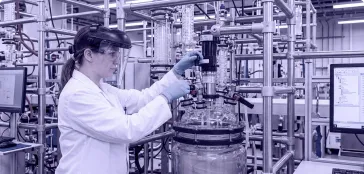
Process chemists
When impurity, mechanism, or condition hypotheses keep growing but the chemistry is still not clear enough.
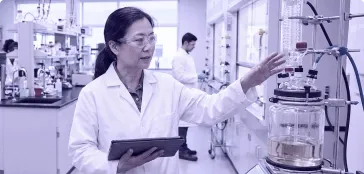
Pharmaceutical R&D leads
When programs need better decisions and clearer technical direction, not just more trial-and-error.
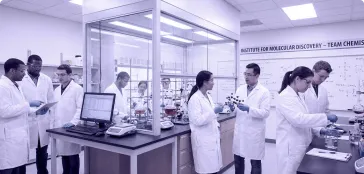
CRO teams
When clients push for results faster than chemical intuition and experimental screening can produce.
What we enable
Instead of working in immense uncertainty, DigitalFlask™ narrows down the problem with mechanistic insights and concrete predictions.
Typical Path
Run wide condition screens to hunt for patterns
Identify impurities as they appear without clearly understanding their formation
Compare route and scale-up options mostly through numerous manual iterations
Make process decisions from fragmented information and long experimentation loops

With DigitalFlask™
Visualize main reaction pathways and side-reactions at the molecular level
Predict route robustness and scale-up-sensitive failure points before committing
Translate the modeling into a shorter, value-focused R&D plan
Focus wet-lab work on the experiments with the highest decision value

You still run experiments.
You just run fewer blind ones and move sooner toward the right answer.
What teams get out of an engagement
The deliverable is not a black-box score. It is a usable mechanistic view of the problem.
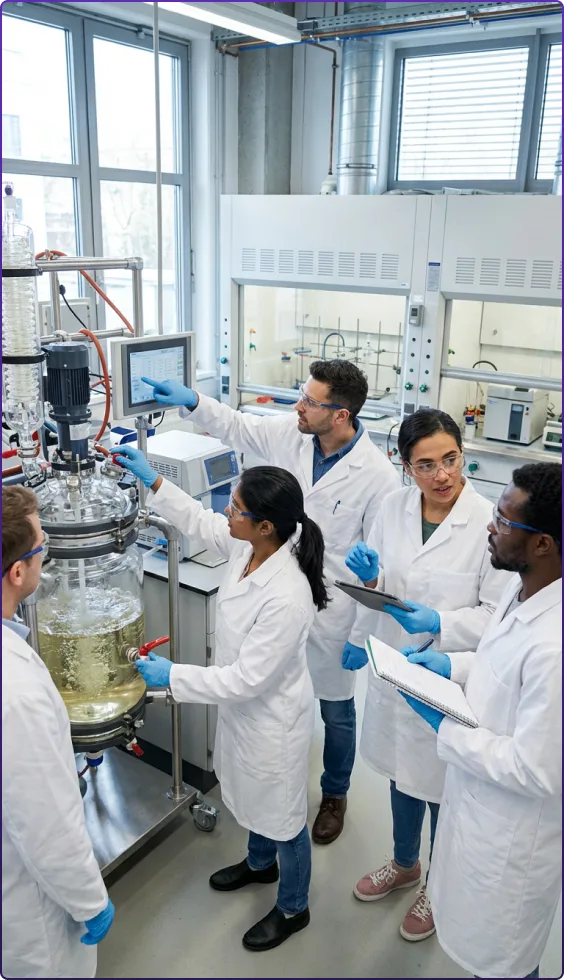

Explain impurity formation
Understand which side pathways are plausible and which conditions are most likely to favor them.
Compare route robustness
See earlier which synthesis options are more tolerant and which are operationally fragile.
Get substrate-specific insight
Base decisions on your actual system, not just literature analogues that may behave differently.
Leave with better next experiments
Go from tentative hypotheses to a complete coherent mechanistic model to leverage.
How to start
Assess how temperature, concentration, stoichiometry, solvent, or catalyst choices are likely to move the system.
- 1
Send us a live case
Share the core reaction details (with a similar or anonymized substrate, if confidential) of your problematic case.
- 2
We assess fit quickly
We tell you within 24 hours whether DigitalFlask™ is a fit, what kind of answer we can provide and an estimated lead time.
- 3
We deliver next-step clarity
You get mechanistic insights, quantitative condition effects and recommendations to complete your reaction optimization.
Who you will talk to
Hexalence is led by computational organic chemistry experts focused on solving real chemical process problems.


Bring us the reaction that just won't behave
Contact us to plan a consultation for your specific substrate or reaction